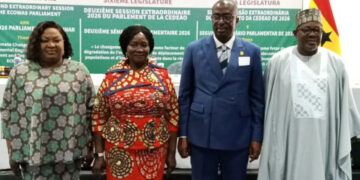






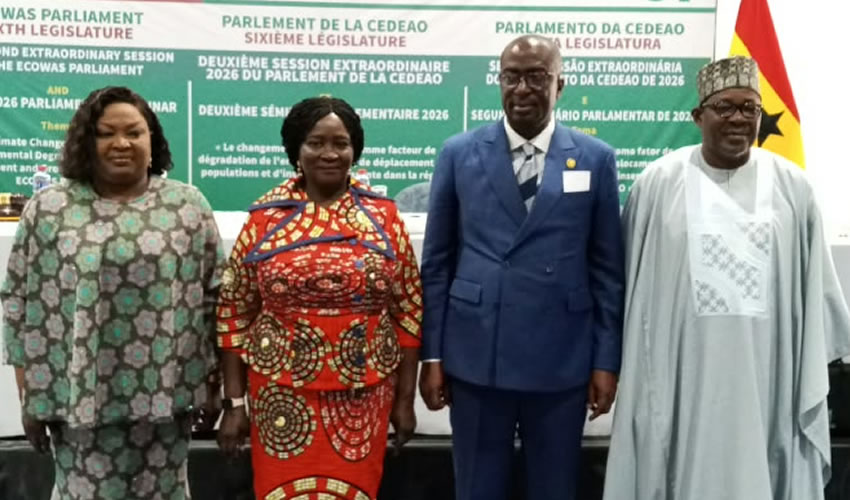
Professor Nassirou Bako-Arifari, Commissioner of Human Development and Social Affairs, has issued a stark warning that climate change could displace up to 32 million people within the ECOWAS sub-region by 2050. Representing the President of the ECOWAS Commission at the Second Extraordinary Session of the ECOWAS Parliament and the Second 2026 Parliamentary Seminar in Accra, the Commissioner highlighted the devastating trajectory of environmental degradation during his address on the theme: “Climate Change as a driver of Environmental Degradation, Population Displacement and Growing Insecurity in the ECOWAS Region.”

Citing World Bank projections, Bako-Arifari noted that the exponential growth in climate risks demands immediate attention, especially as the 2050 timeline coincides with the region’s collective “Vision 2050” commitment to build a zone of peace and prosperity. He revealed that the combined effects of climate change and other insecurities have already led to approximately 12 million displaced persons in Western and Central Africa, the majority of whom are women and children. He underscored the urgency of the situation by requesting a moment of silence for the victims of recent flooding in Ghana and across the sub-region, expressing compassion for the affected families and the destruction of critical infrastructure including roads, schools, and crops.
To combat these challenges, the Commissioner outlined the ECOWAS Commission’s proactive measures, including the adoption of the Paris Agreement in 2015 and the development of a practical guide in 2020 for its implementation. He highlighted the creation of a regional climate strategy targeting 2030 and the 2024 initiative to establish a regional carbon market platform under Article 6 of the Paris Agreement. This mechanism, he explained, is designed to mobilize the necessary investment to address climate financing needs, which are currently estimated at a staggering $294 billion for the region.
Addressing the critical role of legislators, Bako-Arifari emphasized that parliamentarians are uniquely positioned to translate regional commitments into national action through legislative frameworks, budget oversight, and acting as a bridge between governments and citizens. He proposed five key areas of action for consideration: strengthening climate response oversight to ensure laws address environmental protection and disaster risk reduction; prioritizing climate financing through predictable domestic and international resources; and shifting focus to early warning and early action systems to anticipate disasters rather than merely reacting to them.
The Commissioner further advocated for the inclusive management of natural resources—such as land, water, and forests—ensuring that local communities, women, youth, and traditional authorities play a meaningful role in decision-making. Additionally, he called for placing youth and women at the center of climate resilience, recognizing them not just as victims, but as innovators, entrepreneurs, and agents of change. “Investing in their skills, enterprises, and participation is therefore an investment in the future stability of our region,” he stated.
Bako-Arifari concluded by calling for a “new regional compact” that moves from fragmented responses to a comprehensive climate resilience and human security agenda. He argued for a redefined understanding of security, one that encompasses access to food, water, livelihoods, and a safe environment. “We must be proactive and invest in resilience before crisis occurs. We must protect our ecosystem before they become irreversibly degraded,” he urged, adding that the challenge is enormous but within the collective capacity of the region to overcome.
Kwaku Sakyi-Danso/EcowasNewsOnline.com