



For two days, on 29 and 30 October 2026, the University of Lomé hosted an international symposium on African regional courts. Beneath the academic headings on judicial review of constitutional amendments and enforcement of judgments, legal scholars from eight countries assembled, piece by piece, a damning case against the inconsistencies of the ECOWAS Court of Justice. Its judgment of 29 January 2026 against Togo offered a particularly revealing illustration of the Court’s shortcomings.
The theme chosen by the Centre for Public Law was itself an admission: “African regional human rights courts: between safeguarding the rule of law, reviewing constitutional change and respecting state sovereignty.” The word “between” does not belong in such a title when the balance is self-evident.
At the opening, University President Professor Kossivi Hounaké laid down the ground rules. He called for scrutiny of the Court without either blind admiration or outright rejection in the name of insular sovereignty. The discussions soon turned that scrutiny into a diagnosis of the Court’s workings.
A Textbook Example of What to Avoid
Since the Abuja-based Court characterized the constitutional revision of 25 March 2024 as an “unconstitutional change of government” under Article 23 of the African Charter on Democracy, Elections and Governance (ACDEG), judgment ECW/CCJ/JUD/01/26 has become a textbook example of everything a regional court should avoid: ruling without hearing both sides, making a finding without resolving the matter, and issuing orders it cannot enforce.
Dr Christian Trimua, Assistant Professor at the University of Lomé, captured it most precisely in an article with the uncompromising title “Judging Without Authority, Setting Aside Without Legal Basis, Censuring Without Consequence”: a court that acts without established jurisdiction, sets aside a constitution without any empowering provision, and condemns conduct without any practical consequence flowing from that condemnation.
Ruling without hearing both sides, finding without resolving, ordering without the power to enforce: the two days in Lomé did little more than document this threefold indictment.
A Jurisdiction the Court Conferred on Itself
The first flaw is one of principle. The ECOWAS Court of Justice is not a constitutional court. It acknowledges as much itself and recalls, in paragraph 88 of its judgment, that states retain the sovereign power to amend or even replace their constitutions. Yet it proceeds to do precisely what it says it cannot do: assess the “timing,” “content” and “intended effect” of a constitutional revision adopted by a national parliament, promulgated on 6 May 2024 and validated by Togo’s competent institutions.
To pronounce a constitution improperly born without declaring jurisdiction to judge it is to ask others to take the Court at its word.
Presentations during the symposium’s first panel, devoted to regional review of constitutional amendments, exposed this contradiction. They converged on a single question: on what legal basis can a regional judge, petitioned by thirteen private applicants, substitute itself for a member state’s constitutional court in determining the nature of its political system?
In Abuja, the answer was sought in Addis Ababa, in Article 23(5) of the ACDEG, which addresses constitutional amendments that undermine the principles of democratic alternation in power.
Yet that provision was designed to confront coups d’état and third terms secured by force. It was never intended to disqualify a move from a presidential to a parliamentary system—a form of government practised without controversy in the United Kingdom, Germany, India, Italy, Mauritius and Ethiopia. The Court has stretched an anti-coup instrument into a means of policing peoples’ institutional choices.
Professor Adama Kpodar put it plainly: “A transfer of constitutional powers only makes sense within a federation of states, equipped with a federal court to arbitrate between the constituent units and the centre. ECOWAS is not a federation; yet its Court acts as though it were its keystone.”
A Default Judgment That Settles Nothing
The second flaw concerns procedure. The judgment was delivered by default: the Togolese state submitted no defence, and the Court ruled on the applicants’ account alone. Lomé can be criticized for leaving its chair empty, but a ruling based on a one-sided record cannot simply be treated as carrying the same authority as a judgment reached after adversarial proceedings. A court claiming to guard the rule of law should be the first to recognize that a trial without an opposing party produces a lopsided account of the truth.
The third flaw lies in the operative part of the judgment. At point (v), it finds a breach of Article 23 of the ACDEG. The Court’s only concrete direction appears at point (vii), ordering Togo to ensure that “any future constitutional or institutional reform” complies with its international commitments. The word “future” says it all.
The Court calls the Constitution of 6 May 2024 an unconstitutional change of government, but does not annul it, reinstate the 1992 Constitution, or order a transition or national dialogue—terms absent from the judgment’s thirty-nine pages. It condemns an act while leaving all its effects intact. A court that declares a contract fraudulent but allows it to continue being performed is not delivering justice; it is handing out labels.
It is precisely this gap between legal characterization and legal consequence that Togo’s opposition sought to fill in its August memorandum, attributing to the judgment conclusions that it does not contain. Through its own lack of precision, the Court opened the door to such political use.
When the Creation Turns Against Its Creator
The second panel, chaired by Professor Alain Ondoua, tackled what the organizers called the “stress test” of integration: the enforcement of judgments. It was here that Professor Kpodar’s intervention struck hardest.
Before applying a regional instrument, he argued, a national judge must establish that the state’s consent was validly expressed under constitutional procedures governing ratification and deposit. If the commitment was irregular, the state is not validly bound, and the regional court’s jurisdiction falls away before the merits are even examined. Benin’s Constitutional Court has already undertaken such scrutiny. The ECOWAS Court, by contrast, reasons as though a state’s formal accession to a charter were a blank cheque to derive, fifteen years later, obligations to which no one had agreed.
Professor Kpodar offered an image that stayed with the audience: “The creation now wants to surpass its creator and impose its will on it. And the creator resists. Eventually, it breaks.”
States created ECOWAS and its Court. They entrusted them with defined powers. Departures from that original consent fuel tensions that have already contributed to the withdrawal of certain member states. When each ruling is perceived as interference in a member’s constitutional order, it strengthens the arguments of those tempted to follow Mali, Burkina Faso and Niger, which left ECOWAS in January 2025. A court that weakens the organization from which it derives legitimacy commits a strategic error even before it commits an error of law.
The Court has already seen its decisions disregarded by Senegal in the Karim Wade case, by Nigeria over the detention of former national security adviser Sambo Dasuki, and by Yahya Jammeh’s Gambia in the case of missing journalists. Each time, the pattern is the same: the Court rules, the state does not act, and the Court writes again. No coercive mechanism, no competent national authority designated in most states to receive its judgments, and no political follow-through at the level of the Conference of Heads of State. The speakers in Lomé chose their words carefully; the reality is far harsher.
A Follow-Up Letter That Exposes Its Powerlessness
The timing gave the symposium an illustration no organizer could have arranged. On the very day the proceedings opened, a letter from the Court’s Registry to Togo’s Minister of Justice was made public, seeking “follow-up on the implementation” of the 29 January judgment. The Court politely asked the Minister to “kindly inform it of the measures” taken in that regard.
The courteous wording reveals the Court’s lack of coercive power to enforce its decisions. It also raises a prior question: which specific order is Togo supposed to report having implemented?
The only operative direction concerns “future” reforms. A state can therefore reply in good faith that there is nothing to implement, since no new reform is under way. The judgment is framed in such a way that non-compliance becomes indistinguishable from compliance. The Court has signed a decision that no one can breach because no one can put it into effect.
It was this impasse that the roundtable on Friday, 30 October, sought to articulate. General Rapporteur Professor Nadine Machikou argued against reducing the debate to one judgment and urged attention to power relations and the way states receive judicial decisions. The political science scholar emphasized that the effectiveness of a regional judgment depends on the configuration of political majorities, relations among institutions and domestic political will—factors that a court ruling in the abstract deliberately overlooks.
Professor Dodzi Kokoroko, chair of the organizing committee, concluded by calling for dialogue among judges, reminding participants that national and regional courts cannot operate in isolation. It was an elegant way of saying that Abuja had spoken alone—and speaking alone has never made a sound judgment.
The Objection We Can Expect
Defenders of the ruling have a ready answer, and it deserves to be heard before being challenged. Togo signed and ratified the African Charter on Democracy; Article 23(5) specifically addresses amendments that undermine democratic alternation; and the Court merely characterized the facts without interfering with constituent power, as it expressly acknowledges. The state will also be told that it is poorly placed to complain about a judgment rendered in its absence when it chose not to appear. Lawyer Zeus Ajavon summarized that position by publicly questioning what kind of law the academics gathered in Lomé had studied.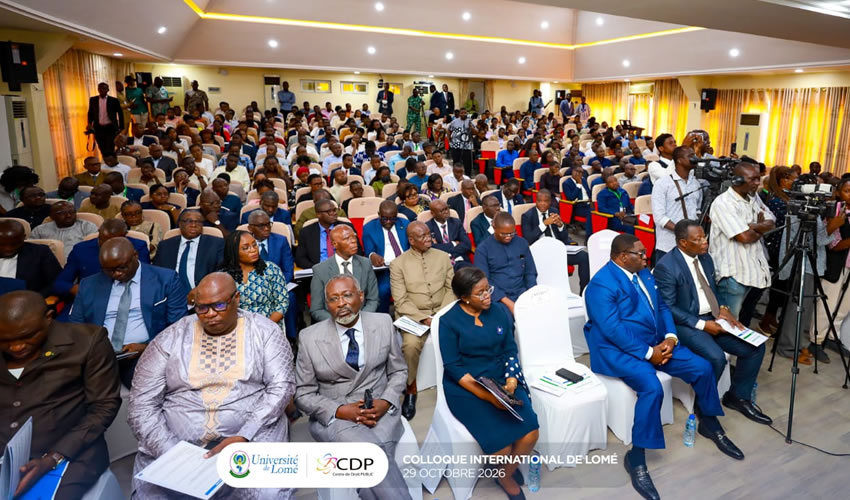
The objection shifts the debate without settling it. No one disputes that Togo is bound by the ACDEG. The issue is whether that Charter gives a regional court, approached by private individuals, the power to assess the “intended effect” of an institutional choice, when—as the Court itself held in the same judgment—it reserves reliance on the Protocol on Democracy to states.
Article 23(5) may exist; it must still be shown that the move to a parliamentary system, in which the executive emerges from a majority elected on 29 April 2025 in a ballot that the Court acknowledges deprived no one of the right to vote, undermines alternation rather than relocating the arena in which it occurs. And yes, the empty chair was a mistake; this article says so without reservation. But it cannot turn incomplete reasoning into sound reasoning. A default judgment remains a default judgment, whatever the absent party’s responsibility.
What the Court Owes to Its Own Credibility
The Lomé symposium was not a show trial of Abuja. The organizers took care to invite a former judge of the Court, Professor Alioune Sall, to deliver the inaugural lecture. He broadened the perspective to include the African Court on Human and Peoples’ Rights and the European Court of Human Rights.
That broader perspective makes the assessment all the more severe. Compared with its counterparts, the ECOWAS Court combines three failings that no regional tribunal can afford at once: jurisdiction expanded through interpretation, proceedings allowed to unfold without adversarial debate, and enforcement beyond its control.
Constitutional diversity is not an anomaly to be corrected. Ghana, Nigeria and Senegal have presidential systems; Mauritius, Ethiopia and South Africa do not. No African charter imposes a single model, and no court has been mandated to invent one. By calling an institutional choice an “unconstitutional change of government” without attaching any consequence, the Court has handed the opposition a symbolic victory, the state an argument from authority, and the region a precedent that every government will remember the next time it considers whether to appear before the Court.
By: Dibalba is a political analyst.